

Press brakes are the undisputed workhorses of the sheet metal fabrication industry. A modern CNC press brake is a marvel of precision engineering, capable of holding tolerances down to a thousandth of an inch. However, the machine itself is only half of the equation. The tooling—the punches and dies that make physical contact with the metal—determines the ultimate success or failure of a bend.
Despite the critical role press brake tooling plays, it remains widely misunderstood. Operators often rely on outdated “rules of thumb,” while management can view press brake tooling as a generic commodity rather than a precision asset. Misjudging how punches and dies interact with different materials leads to high scrap rates, damaged equipment, and severe safety hazards. Let’s clear up the most pervasive and costly misconceptions surrounding press brake tooling.
Misconception: Any punch and die combination is fine as long as the material physically fits inside.
The relationship between material thickness and the V-die opening is a rigid mathematical rule, not a suggestion. For standard cold-rolled steel, the industry standard for air bending is an 8-to-1 ratio—the V-die opening should be eight times the thickness of the material.
Mismatching this ratio has cascading consequences. If you use a die that is too narrow, the required tonnage skyrockets, and the metal is likely to crack along the outside of the bend. If you use a die that is too wide, the inside bend radius becomes larger, throwing off your established bend deductions and flat pattern calculations. You must match the die to the material thickness to maintain dimensional accuracy.
Misconception: If the machine struggles to make the bend, you just need to increase the tonnage.
Cranking up the machine’s force to bend thicker material on a narrow die is one of the most dangerous things a press brake tooling operator can do. Every individual punch and die has a strict maximum rated tonnage per foot (or per meter).
When you force a bend by overriding pressure limits, the sheet metal acts as a wedge. This extreme lateral pressure can physically split a V-die in half or shatter a punch tip, sending hardened steel shrapnel out across the shop. If a bend requires more tonnage than the tooling is rated for, the only safe solution is to increase the V-die opening, which reduces the required force.
Misconception: To get a 90-degree bend, you must use a 90-degree punch and a 90-degree die.
This myth ignores the physical reality of “springback.” When sheet metal is bent and the pressure is released, the material naturally relaxes and springs open slightly due to its inherent elasticity.
To achieve a true 90-degree final angle in air bending, you must actually overbend the material by a few degrees. Therefore, standard air bending tooling is typically manufactured at 85, 86, or 88 degrees. This allows the punch to push the material past 90 degrees, so it can perfectly spring back into a 90-degree resting state.
Misconception: Bottom bending and coining are the same thing.
While both methods involve the punch pressing the material fully into the die, they operate on entirely different mechanical principles.
Coining is an antiquated method that requires massive tonnage—often three to five times that of air bending. It physically stamps the punch tip into the neutral axis of the sheet metal, thinning the material and permanently realigning its molecular structure to eliminate springback.
Bottom bending uses significantly less force. The punch pushes the material down until it conforms to the die angle, but it does not penetrate the neutral axis. Today, with the advent of highly accurate CNC press brake tooling, most fabrication is done via air bending, where the inside radius is determined solely by the width of the V-die opening and the depth of the punch’s descent.
Misconception: All press brake tooling is universally interchangeable.
There are several distinct press brake tooling styles globally, with the most common being American, European, and New Standard (Wila/Trumpf). They are entirely different ecosystems.
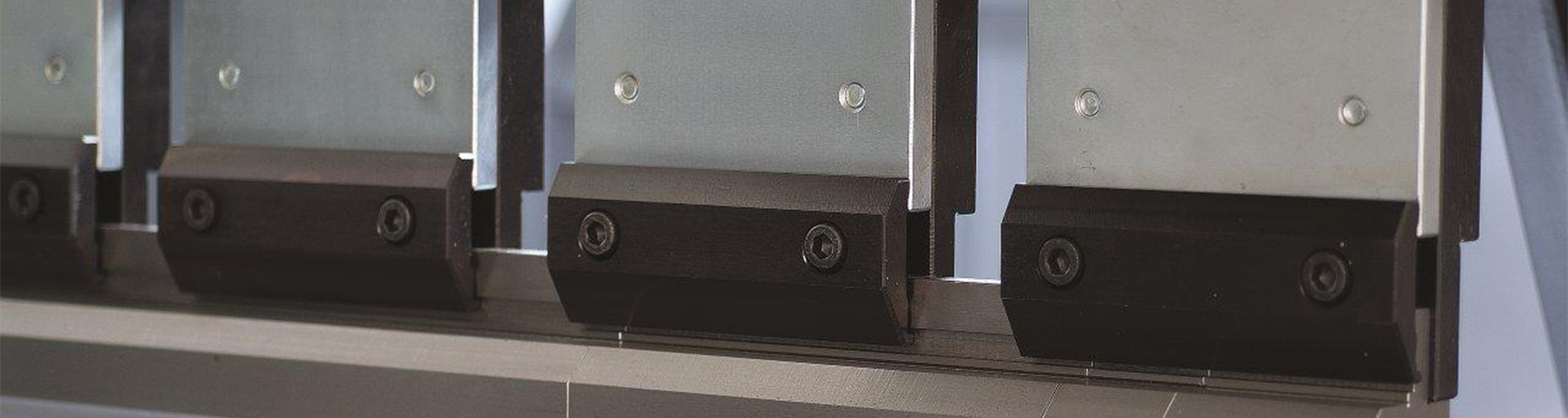
American press brake tooling is traditionally non-precision planed and relies on the operator to center and align the tools manually. European press brake tooling features an offset tang and is precision-ground. New Standard press brake tooling uses a single-point locking mechanism, clicks into place automatically seated and centered, and is designed for rapid tool changes. Attempting to modify one style to fit a machine designed for another compromises the structural integrity of the tool and destroys its precision.
Misconception: Specialized tooling is an unnecessary luxury.
Fabricators often waste hours attempting complex workarounds with standard straight punches, risking part collisions and inaccuracies. Specialized shapes like gooseneck punches are designed specifically to clear deep return flanges that would otherwise crash into a straight tool. Investing in segmented tooling and specialty profiles dramatically improves everyday setup times and expands a shop’s capabilities.
Misconception: Tooling only needs to be replaced if it is visibly chipped or snapped.
Press brake tooling is subjected to immense friction, particularly along the two upper shoulders of the V-die where the sheet metal drags during a bend. Over time, this microscopic wear flattens the die shoulders.
This subtle wear drastically alters the mechanics of the bend, changing the inside radius and causing the bend angle to become inconsistent. Because operators often bend small parts in the exact center of the machine bed, the center of the tooling wears out faster than the edges. This can create a “canoe” effect—an error where a piece of sheet metal has a correct bend angle at the ends, but an open, under-bent angle in the center—making it impossible to bend a long part accurately across the full length of the bed. Press brake tooling should be routinely measured with precision calipers or micrometers to check for shoulder and tip wear.
Misconception: Cleaning tooling between setups is a waste of production time.
When bending materials like galvanized steel or aluminum, mill scale, zinc dust, and metal shavings actively flake off and weld themselves to the die shoulders—a process known as galling.
If this buildup is not removed, it essentially changes the geometry of the die. Worse, this hardened buildup will gouge deep scratches into every subsequent piece of metal you bend, ruining the cosmetic finish of the parts. Taking two minutes to wipe down the die shoulders with a non-abrasive pad and applying a light coat of rust-preventative oil saves countless hours of reworking scrapped, scratched parts.
Proficiency Precedes Precision
Mastering press brake operation means treating your tooling as a set of precision instruments rather than blunt-force objects. By rejecting these common misconceptions that have been passed down through the years by well-meaning but mistaken press brake operators, you can dramatically increase both tooling life and part accuracy. Adopting the principles listed above are the first steps toward a more efficient, profitable, and safer fabrication floor.


