

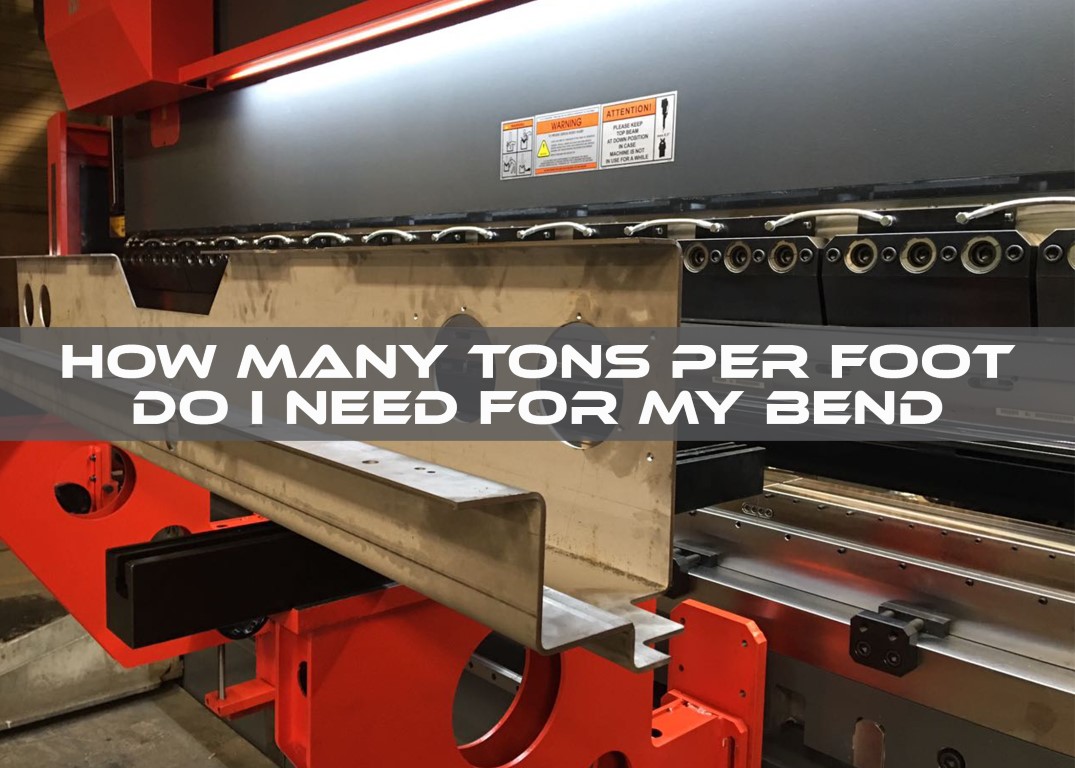
If you work with press brakes, a frequent concern will be if you have the right amount of tonnage to perform each bend. Getting the number wrong can be incredibly frustrating. Underestimating means your machine stalls out or leaves you with an incomplete, under-bent part. Overestimating is far more dangerous—you can easily deform your tooling, crush your die, or permanently fracture your press brake’s bed.
To form sheet metal safely and accurately, you need to understand tonnage per foot. This represents the baseline forming force required to bend a specific material thickness over a specific die opening across a one-foot length. Once you know this baseline number, scaling it to the actual length of your part is straightforward.
What Variables Drive the Tonnage?
Tonnage is not a generic number based solely on metal thickness. It is an evolving relationship between three critical variables:
- Material Thickness (t). As a rule, tonnage requirements scale quadratically with material thickness. Doubling the thickness of your sheet metal does not double the required force—it quadruples it.
- Material Ultimate Tensile Strength (UTS). Harder materials resist deformation. The industry baseline is standard mild steel, rated around 60,000 psi (400 MPa). If you are forming stainless steel or high-strength structural alloys, your tonnage needs will skyrocket.
- Vee-Die Opening Width (V). This is the ultimate leverage point. A wider die opening gives the punch more leverage, drastically reducing the force required to make the bend. Conversely, forcing metal into a narrow die opening demands massive amounts of pressure.
Choosing Your Die Opening (The 8x Rule)
Before calculating tonnage, you must determine your die opening. For standard air bending—where the material only touches the two top corners of the die and the tip of the punch—the golden rule of fabrications is the “8x rule.”
For optimal forming behavior, select a V-die width that is roughly 8 times your material thickness (V = 8t).
- For thin gauges (under 14 gauge), shops sometimes drop to a 6t or 8t die to achieve tighter inside radiuses.
- For thick plates (greater than 1/2 inch), fabricators frequently scale up to a 10t or 12t die to keep the tonnage requirements within safe operating limits for their machinery.
The Math: Calculating Tonnage per Foot
To calculate the required force for air bending standard mild steel, use the standard empirical fabrication formula:
P = 575 times t-squared over V
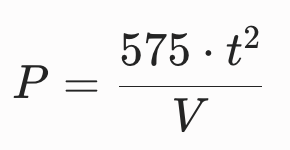
Where:
- P = Tonnage required per foot (U.S. tons/ft)
- t = Material thickness (inches)
- V = V-die opening width (inches)
Here is an example using the formula to calculate the requirements for bending a 1/4-inch (.250″) mild steel plate using the standard 8x die selection:
- Find your die opening (V): Multiply 0.250 × 8 = 2.0 inches.
- Square your thickness (t2): 0.250 × 0.250 = 0.0625.
- Multiply by the constant: 575 × 0.0625 = 35.9375.
- Divide by the die opening (V): 35.9375 / 2.0 = 17.97 tons per foot.
To bend this 1/4-inch plate over a 2-inch die, you need roughly 18 tons of force for every foot of material length. If your part is 6 feet long, multiply your baseline by the length:
18 tons/ft × 6 ft = 108 total tons
Material Factor Adjustments
The formula above assumes you are bending standard mild steel. Because different metals offer varying levels of resistance, apply a multiplier to your final tonnage calculation based on the material type:
- Soft aluminum has an approximate tensile strength of 30,000 psi, so it requires a tonnage multiplier of 0.50 (in other words, 50% less force).
- Mild steel has an approximate tensile strength of 60,000 psi, requiring a tonnage multiplier 1.00 (in other words, it’s the baseline material used for these calculations).
- Stainless steel (304) has an approximate tensile strength of 90,000 – 100,000 psi, requiring a tonnage multiplier of 1.50 (50% more force).
- High-strength alloys have an approximate tensile strength of 120,000 psi or more, requiring a tonnage multiplier of at least 2.00 (double the force).
If the 6-foot part from our previous example were made from 304 stainless steel instead of mild steel, the adjusted requirement would be:
108 tons × 1.5 = 162 total tons
Reading a Tonnage Chart
Most manufacturing facilities keep a standard tonnage chart riveted directly to the side of the machine frame for quick reference.
To use a chart effectively:
- Locate your material thickness or gauge along the vertical axis.
- Follow the row horizontally until you find your specific V-die opening width listed along the top horizontal axis.
- The intersecting number tells you the exact tons per foot needed.
Charts also provide a helpful shortcut for determining your minimum readable flange layout. The chart will typically list a secondary number showing the shortest possible lip you can safely bend without the metal slipping down into the die cavity.
Air Bending vs. Bottoming vs. Coining
The formulas and charts used across the industry are exclusively calculated for air bending. If your shop floor relies on alternative forming styles, your tonnage math changes completely:
- Bottoming. This involves pressing the punch down until the material fully conforms to the V-die angle (usually 90 degrees). Because you are squeezing the material at the bottom of the stroke, bottoming requires 3 to 5 times more tonnage than air bending.
- Coining. This process actually thins and indents the metal plate between the punch tip and the bottom of the die to eliminate springback completely. Coining requires massive, dangerous amounts of force—often 5 to 10 times the tonnage of air bending. Trying to coin a part using an air-bend tonnage calculation will instantly stall or damage your machine.
Concentrated Load Limits
There is one final trap that catches many operators: concentrated load limits. Just because you own a 100-ton press brake does not mean you can safely apply all 100 tons over a narrow space.
Press brakes have a maximum tonnage limit per foot engineered into their structural frames (for example, a 10-foot, 100-ton machine is structurally rated for an even distribution of 10 tons per foot).
If you attempt to bend a thick, heavy steel bracket that is only 6 inches wide, and it requires 40 tons of force to form, you are concentrating 80 tons per foot onto a tiny section of the machine bed. This exceeding of the localized limit can cause deep indentation scars across your bed, bend your ram out of alignment, or shatter your tooling. Always check your machine manual’s maximum concentrated load threshold before executing short, heavy bends.
The Difference Made by Mastering Tonnage
A beginning press brake operator may feel reluctance in learning the math necessary to fully apply the principles of calculating “tons per foot.” They might feel that just glancing at a tonnage chart and “winging it” is enough to get a bend that’s “good enough.”
However, understanding how to calculate required tonnage is critical because it allows operators to scale force properly to bend specific thicknesses and lengths of specific types of material to specific angles, and to do so while preventing dangerous overloads that could damage the part, the tooling, the machine itself, or even the people standing nearby.
Mastering the concept of tons per foot bridges the gap between simply running a machine in a shop and becoming an elite, highly valued metal craftsman in the industry.


